
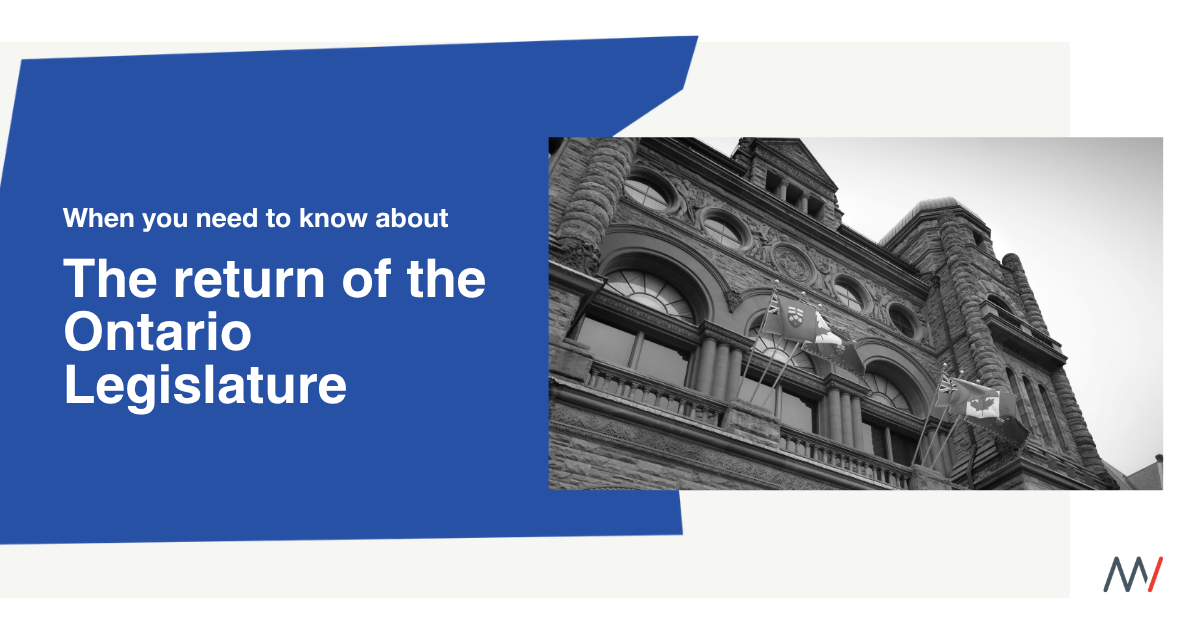
The Spring Session of the Ontario Legislative Assembly begins on March 23, 2026, following an extended winter recess. All eyes are on Budget 2026, scheduled to be tabled on March 26 by Finance Minister Peter Bethlenfalvy.
The Ford government spent much of 2025 advancing a Protect Ontario policy agenda across trade, procurement, housing, and energy policy areas. The spring session provides an opportunity to operationalize those policy changes while introducing new fiscal measures through Budget 2026. Minister Bethlenfalvy has signaled that the upcoming budget will prioritize productivity, competitiveness, innovation, and infrastructure investment, against a backdrop of economic risks and tariff-related uncertainty and will be underpinned by efforts to address the province’s projected deficit of approximately $13.4 billion.
Ontarians should expect spending cuts in non-essential program areas and moves to create more fiscal flexibility to enable the province to respond to a technical recession in fiscal year 2026-2027. This follows increasing unemployment and shrinking per-capita GDP growth over the past year.
Key budget themes:
- Continued support for manufacturing and export sectors affected by U.S. tariffs and global trade volatility.
- Targeted affordability measures for households and small businesses.
- Investments in health, transportation, energy, and housing infrastructure.
- Fiscal management while maintaining significant capital spending.
LEGISLATIVE PRIORITIES & KEY POLICY AREAS
Housing Pressure and Development
Housing supply remains a central policy priority for the government, which has set a target of 1.5 million new homes by 2031. Continued housing shortages are driving additional policy responses, including the proposed removal of HST on new homes for first-time home buyers up to a value of $1 million.
The government is also expected to pursue further measures to accelerate housing approvals and construction timelines. Implementation of previous housing legislation will continue, including measures to reduce municipal planning barriers and support growth infrastructure through legislation such as Bill 17 and Bill 60.
Infrastructure and Major Projects
Infrastructure investment remains a cornerstone of the government’s economic strategy. Priority areas include:
- Energy infrastructure to support industrial expansion and electrification
- Transportation and regional infrastructure projects linked to population growth
- Economic development initiatives tied to manufacturing, technology, and critical minerals
A major focus remains on the Ring of Fire, where Ontario continues to advance legislation and regulatory changes to support approvals for major resource projects, particularly for critical mineral development. Recent policy initiatives have aimed to reduce approval timelines for mining projects, and the government has already announced agreements with First Nations partners on the “Road to the Ring of Fire”.
Other Major Policy Areas
- Environmental Regulatory Reform: The government is moving forward with a restructuring of Ontario’s conservation authorities, consolidating 36 authorities into nine to streamline oversight and reduce administrative duplication. Additional regulatory reforms aimed at reducing approval timelines and cutting red tape for large-scale projects.
- Health Care Capacity: Premier Ford’s government will continue to expand publicly funded care through licensed community surgical and diagnostic centres, including new orthopedic centres in Toronto, Richmond Hill, Ottawa, and Windsor, framed as a wait‑time and capacity solution amid structural funding gaps within hospitals.
- Education Funding: The province recently announced this past February that $6.4 billion in new funding over four years for colleges and universities, alongside several structural changes to the sector, including lifting the 7‑year tuition freeze and restructuring OSAP. Starting Fall 2026, a maximum of 25% of assistance is grant‑based and at least 75% is loan‑based.
WHAT’S NEXT?
For businesses and organizations in Ontario, the upcoming legislative session will present policy opportunities and potential regulatory changes, with a focus on economic growth, project approvals, and housing supply, and Budget 2026 will act as the central policy vehicle for this. Organizations with interests in infrastructure, mining, housing development, manufacturing, and energy should expect continued government attention to policies that accelerate project development.
The session will also provide signals about how the Ford government intends to balance economic competitiveness, environmental considerations, and fiscal pressures during a pivotal year in the Canada-US trade relationship.
Team Vantage will continue to do the following:
- Provide an in-depth analysis of Budget 2026.
- Monitor key legislation and bills as they are tabled throughout the session.
- Support early engagement with relevant ministries for streamlined projects in Ontario.
Every sector of the economy is being affected, directly or indirectly, by a growing lack of predictability. Never has geopolitics played such a significant role in shaping the domestic agenda of a provincial government. Ministers, staff, and elected officials are focused on understanding how best to manage current challenges while preparing for future risks. In this environment, it is critical for businesses and organizations to engage directly with the government to inform decisions that will strengthen the economy. Our team is ready to support you in communicating your story to key decision-makers, starting today.
If you’re looking to get your issues on the agenda at Queen’s Park this Spring, contact us today at info@mcmillanvantage.com.
Team Vantage is here to help you navigate this fast-changing environment and position your company for success
