
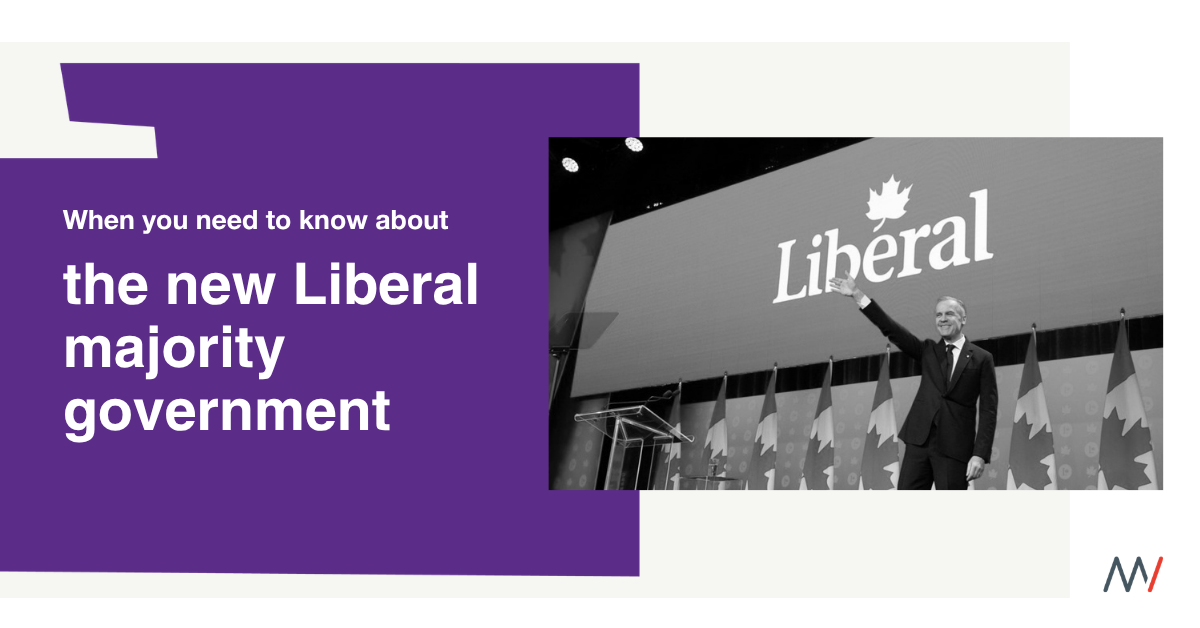
Prime Minister Mark Carney has a majority government, after the Liberal Party of Canada swept all three key by-elections in Toronto and Quebec. Victories in University–Rosedale, Scarborough Southwest, and Terrebonne.
The three victories, combined with five recent floor-crossings, have pushed the Liberals over the threshold needed to govern with a majority.
Carney’s strong minority has, in a matter of days, turned into a fragile majority. While the Liberals will now enjoy the technical benefits of a majority (more on that below), maintaining the balance of power will require deft caucus management and a strong hand ot whip caucus on key votes.
Here’s what you need to know about the new Liberal majority government:
What matters
The implications are significant. A government that was navigating vote-by-vote dynamics now has greater latitude to advance its agenda with more certainty and speed. With the Spring Economic and Fiscal Update on the horizon, significant legislation on privacy and online harms expected this spring, major spending and procurement changes still underway in defence, and CUSMA negotiations set to formally begin on July 1, the Prime Minister now has more room to manoeuvre as these issues come into focus.
That said, the majority remains slim, so the government whip will need to maintain tight control over attendance on key votes and matters of confidence. The margin for error is now more forgiving, but not by much.
A quick reminder of the math
There are 343 seats in the House of Commons. After the floor crossings, the Liberals had 171 seats, the Conservatives 140, the Bloc Québécois 22, the NDP six and the Greens 1.
172 seats would technically be a majority of seats, but that includes the Speaker of the House, a Liberal MP. Since the Speaker only breaks ties to maintain the status quo in parliament (usually limited to supporting the government in confidence votes), for practical purposes, the government would lack a functional majority unless it reaches 173.
After winning all three seats on Monday, the Liberals now have 174 seats, which gives them two seats to play with if someone needs to resign for personal or professional reasons.
Committee proceedings are smoother
The Liberals will be able to reconstitute committees to reflect their majority status without proroguing, which Prime Minister Carney has suggested is his preference.
A majority government means the opposition loses the ability to force the release of documents the Liberals don’t want to share, or to force ministers to appear for questioning. Mandatory document production is a preferred opposition tactic, and compliance requires significant government effort (and risks possible embarrassment).
A majority will also allow the government to move legislation through committee more smoothly, avoiding unwanted amendments and filibusters.
Confidence votes are easier, and bills will pass faster
Even a slim majority allows the government to push through bills and maintain the confidence of the House of Commons much more easily. An interesting detail: MPs can now vote electronically anywhere in Canada. This means less racing back to Parliament Hill in a crisis. But with just a few voters to make or break their majority, the government could still fall if a couple of MPs get caught somewhere without a cell signal or wifi. Ministers’ international travel may still be restricted, too. It will be up to Chief Government Whip Mark Gerretsen to ensure that every Liberal MP is available for every vote, and especially confidence votes.
What this means for U.S.-Trade and CUSMA talks
A majority mandate offers the Carney team stability at a moment when the world and our most important trading relationship are increasingly unstable.
CUSMA trade talks are scheduled to officially begin July 1, and now Carney and his team can go into that knowing they can get parliamentary support for any deal they come out with. It also allows them to focus on the talks without worrying about the need to call an election back home.
At a moment when the ongoing conflict with Iran is disrupting the global energy supply chain, Canada enters those talks from a renewed place of strength. Expect many Canadians to also appreciate the stability at home amid the global tumult.
Opposition implications
Just over a year ago, it was commonly expected that Pierre Poilievre would lead the Conservatives to a majority government. Now, there are questions about the future of his leadership as Carney forms a majority.
Expect the CPC to continue to hammer the Liberals on an “undemocratic” path to largely unchecked power, but it’s a hard message to sell when voters, not floor crossers, ultimately made the majority.
There are ongoing rumours of more floor crossers to come, and others that some CPC MPs may simply resign their seats in protest. The Conservative caucus has the power to force a secret ballot to turf their leader, even after the membership endorsed Poilievre in January.
New NDP leader Avi Lewis has six seats and a party without status, but he still holds a national microphone to push for progressives disillusioned with Carney’s centrist government to return to the more socialist party.
Both men have a long runway ahead of them to make their case to voters — and their divided parties about why they are best positioned to chart the course forward.
Timing of the next election
Carney likes to govern. He’d rather be in 80 Wellington Street than on a campaign plane. Expect him to govern with his majority as long as possible. While some still say he should seek an even bigger majority while the Liberals are riding high in the polls, those close to him suggest that’s just not his style.
He would prefer to get to work — and perhaps get a few more folks from across the aisle to join him, just in case.
If you’re looking for more information about what the new majority means for you and your business, contact us today at info@mcmillanvantage.com.
Team Vantage is here to help you navigate this fast-changing environment and position your company for success.
